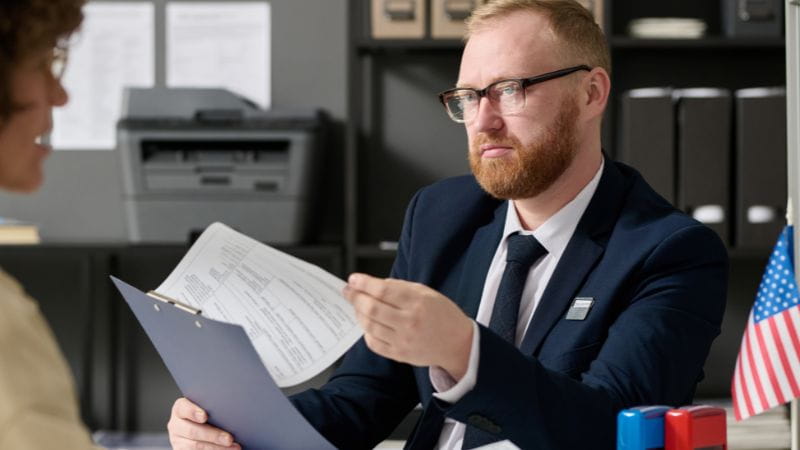
For many Brazilians, the consular interview is the most stressful part of the entire American visa process.
Short, direct, and decisive, it usually lasts only a few minutes—but it can define the outcome of your entire plan.
What many people don’t know is that the interview isn’t based on luck or subjectivity. There’s a clear logic behind the consular officer’s assessment.
In this comprehensive guide, you will understand what is actually evaluated, how to prepare correctly, and what mistakes to avoid to increase your chances of passing.
What is the purpose of a consular interview?
Contrary to what many believe, an interview is not an interrogation.
The consular officer’s objective is simple: to verify that you meet the criteria for the requested visa.
For tourist visas (B1/B2), for example, the analysis revolves around a central point:
Do you have clear reasons for returning to your country of origin?
In other words, the focus is not just on your trip — but on your intentions and your profile as a whole.
What the officer actually assesses
During the interview, the officer analyzes a set of factors quickly and objectively:
1. Consistency of information
Everything needs to make sense:
- what you declared on the form
- what do you say in the interview
- your personal and professional history
Any inconsistency can generate doubt.
2. Clarity in the purpose of the trip.
You need to demonstrate that you know exactly:
- why are you going
- what do you intend to do
- How long do you plan to stay?
Vague or confusing answers are one of the main reasons for rejection.
3. Links with Brazil
This is one of the most important points.
The officer wants to understand if you have genuine reasons to return, such as:
- stable job
- active company
- studies
- family
- heritage
It’s not about wealth — it’s about stability and context.
4. Security when responding
The way you respond is also analyzed.
- objective answers
- safe tone
- naturalness
Excessive hesitation or insecurity can raise doubts.
5. Migration history
The American system records:
- entrances and exits
- previous views
- length of stay
- possible irregularities
Their immigration history may directly influence the decision.
Main mistakes that lead to a negative result.
Many rejections could be avoided with proper preparation.
Here are the most common mistakes:
❌ Lack of clarity in the answers
❌ Inconsistent information
❌ Wrong visa type selection
❌ Lack of demonstrated connection
❌ Too much unnecessary information
❌ Answering more than what was asked
Remember: the interview is objective. Long or confusing answers can be detrimental.
How to prepare correctly
Preparing for an interview isn’t about memorizing answers—it’s about understanding your own process.
Here are the key points:
✔️ Review the DS-160 form
Everything you say needs to be consistent with what has been filled out.
✔️ Be clear about your trip
Let me explain it simply:
- destination
- reason
- duration
✔️ Organize your history
Understand your own professional, financial, and personal journey.
✔️ Practice your communication
How you respond is just as important as the content.
✔️ Avoid improvisation
Improvising increases the risk of inconsistency.
Preparation reduces anxiety and increases confidence.
The interview is quick — but strategic.
Most interviews last only a few minutes.
This means that the officer makes the decision based on:
- quick perception
- answer pattern
- overall consistency
There is no time to “convince”.
What exists is confirmation of what is already clear.
The importance of strategy in the process
Many people believe that the outcome depends solely on the individual’s profile.
But in practice, what makes the difference is:
- how the profile is presented
- which visa was chosen
- how the information was organized
- the level of preparation for the interview
Two candidates with similar profiles can have completely different results.
Conclusion: Information changes the outcome.
The consular interview is no mystery — but it does require preparation.
Those who understand the process:
- respond with more confidence
- avoids common mistakes
- It conveys clarity.
- increases your chances of approval
Visa Finder monitors visa processes daily and knows exactly what makes a difference at this stage.
If you want to go through the interview with confidence and strategy, start with proper guidance.
Take the next step.
If you are preparing to apply for your American visa, don’t leave this step to chance.
Visa Finder helps you with:
- profile analysis
- defining the best strategy
- complete interview preparation
- guidance at each stage of the process
Speak to Visa Finder and increase your chances of approval safely.